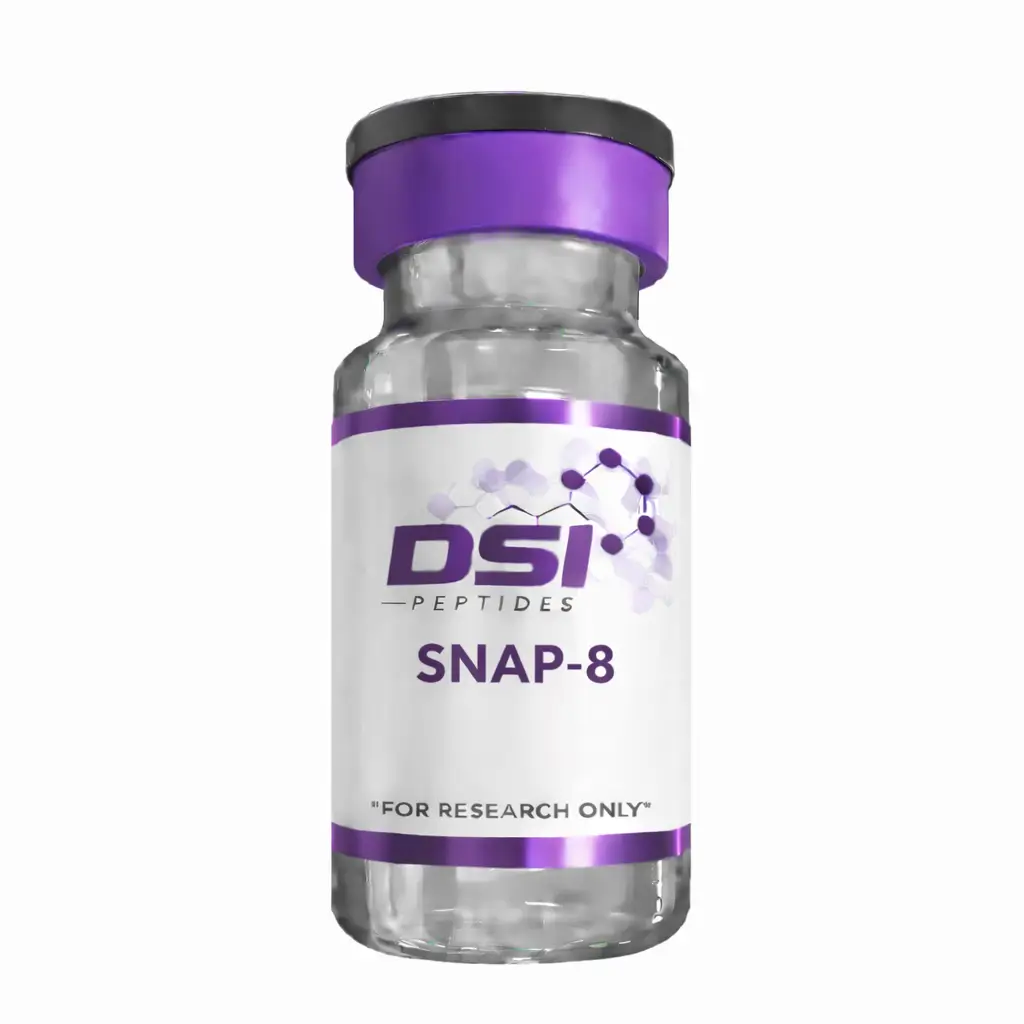
SNAP-8 is a synthetic peptide commonly studied in biochemical and dermatological research for its effects on neurotransmitter release and muscle contraction pathways. Its full name is Acetyl Octapeptide-3, and it is structurally derived from a fragment of the SNAP-25 protein, which plays a key role in synaptic vesicle fusion.
Mechanism of action (research context):
SNAP-8 mimics part of the SNARE complex (Soluble NSF Attachment Protein Receptor), which is essential for the release of neurotransmitters at synapses. By competitively interfering with SNARE complex formation, SNAP-8 can reduce the release of neurotransmitters such as acetylcholine. In experimental systems, this leads to decreased muscle contraction signaling.
Key properties:
- Structure: Short synthetic octapeptide (8 amino acids)
- Parent inspiration: SNAP-25 protein fragment
- Functional class: SNARE complex modulator / neurotransmission inhibitor
- Stability: More stable than earlier peptides like SNAP-25 fragments due to sequence optimization
Research applications:
- Studying synaptic vesicle docking and fusion mechanisms
- Investigating neuromuscular signaling pathways
- Modeling partial inhibition of neurotransmitter release without complete blockade
- Exploring peptide-based modulation of acetylcholine-mediated signaling
- Comparative studies with botulinum toxin mechanisms (at a much milder, reversible level in vitro)
Functional effects observed in studies:
- Reduction in neurotransmitter exocytosis
- Decreased muscle fiber contraction in model systems
- Modulation of signal transmission at neuromuscular junction analogs
Distinguishing features:
- Acts upstream of neurotransmitter release rather than blocking receptors
- Produces reversible and partial inhibition, making it useful for controlled experimental modulation
- Does not enzymatically cleave SNARE proteins (unlike botulinum toxins), but instead interferes through competitive interaction
Limitations in research:
- Effects are generally modest compared to more potent neurotoxins
- Activity depends on peptide stability and delivery in the model system
- Primarily studied in vitro or in topical/skin-related experimental models rather than systemic applications
Overall, SNAP-8 is used as a tool compound to explore mechanisms of neurotransmitter release and neuromuscular signaling, particularly where a mild, reversible modulation of synaptic activity is desired.

Reviews
There are no reviews yet.